WISLI Research Symposium
The annual WISLI Research Symposium brings together the broader WISLI community to celebrate original research across disciplines, languages, and world regions. Students from across WISLI programs presented work connected to Brazilian, Central Eurasian, Middle Eastern and Mediterranean, South Asian, Southeast Asian, and transnational contexts.
The symposium offered an opportunity to engage with a wide range of academic topics, support peers and colleagues in their language and regional studies, and participate in thoughtful scholarly exchange. Presentations were organized into thematic sessions, each followed by a moderated Q&A.
Past panels have featured research on economics, politics, arts, literature, linguistics, second language acquisition, land development and economy, intercultural collaboration, identity, sports, health, colonialism, religious studies, military studies, film studies, and more.
The 2027 Call for Abstracts and Symposium Schedule will be announced at a later date. See below for examples of previous year’s schedules.
2026 Symposium Schedule
Friday, July 3 | 8:30 a.m. – 12:00 p.m. (CDT)
Session 1: Power, Space, and Social Transformation
| Time (CDT) | Breakout Room 1 Mobility, Migration, and Transnational Belonging | Breakout Room 2 States, Infrastructure, and Political Systems | Breakout Room 3 Knowledge Systems: Bodies, Objects, and Texts |
|---|---|---|---|
| Moderator | Zhi Z. (CESSI) | Xiaoying L. (SEASSI) | Naomi G. (SASLI) |
| 8:45 a.m. | “The Impact of Language Barriers on Occupational Training and Perceived Risk among Myanmar Migrant Workers” Ang L. (SEASSI) | “Tale of Two Cities: Urban Planning in Kazakhstan’s Metropoles” Colin E. (CESSI) | “Deciphering Devotional Objects from Qajar-Era Iran: An “Amulet” at the Chazen Museum of Art” Richard E. (MEDLI) |
| 9:10 a.m. | “Embodied Homes: Religious Homemaking Through the Physical and Emotional Choreographies of Kathak in North American and European Indian Diasporas” Kevli S. (SASLI) | “Ancestors & Infrastructure: Reimagining Bandung via the works of Riyadhus Shalihin” Loke Z. (SEASSI) | “Analyzing Tiered Blood Management Systems in Thailand” Kiana D. (SEASSI) |
| 9:35 a.m. | “Shifting Spaces, Shifting Tongues: Globalization and Changing Conceptions of Land Among the Indigenous Hach Winik” Maya M. (SASLI) | “Mikhail Pavlovich and Early Soviet Studies of Imperialism and Colonialism” True S. (SEASSI) | “Integrative Bioinformatics and Structural Analysis of T-Cell Receptors in COVID-19 Immunotherapy” Antonio M. (SEASSI) |
| 10:00 a.m. | “Jugāḍ karna: Tinkering, Repair, and the Messy Relations of Hindi-Language Audio Amplifier Communities” Tyler T. (SASLI) | “The Relationship Between Employment Rates and Terrorism: An Analysis of Political Violence” Anna P. (SEASSI) | “What is the weight of light?: re/constructing joy in Clarisse Lispector’s The Hour of the Star” Liliana L. (SIPI) |
Session 2: Identity, Language, and Cultural Meaning
| Time (CDT) | Breakout Room 1 Language, Contact, and Social Meaning | Breakout Room 2 Religion, Authority, and Cultural Transmission | Breakout Room 3 Gender, Narrative, and Social Agency |
|---|---|---|---|
| Moderator | Maya M. (SASLI) | Colin E. (CESSI) | Loke Z. (SEASSI) |
| 10:45 a.m. | “Can speakers learn unnatural patterns? Evidence from Uyghur neutral vowels” Zhi Z. (CESSI) | “Mongolian Loanwords in Burkhanist liturgies” Gregory Z. (CESSI) | “The Centrality of Gender in the Pembillai Orumai Women’s Strike” Sangeeta S. (SASLI) |
| 11:10 a.m. | “The importance of toponymy in the study of signed language contact, variation, & change” Tran T. (SEASSI) | “Classical Yoga vs Recognition School: How Metaphysics Determines the Value of Yogic Practice” Nino R. (SASLI) | “Bride Kidnapping and the New Narratives: How Public Commentary Creates Narratives and Perspectives on Bride Kidnapping in Central Asia” Naomi G. (SASLI) |
| 11:35 a.m. | “Queer Vernacular, Affect, and Kinship among Thai Youth: Feeling “Real” Through Language” Peyton R. (SEASSI) | “Veneration, Care, and Maechi’s Religious Autonomy in Thai Buddhism” Xiaoying L. (SEASSI) | “More Than Victims: Christianity as a Resource for Charity Practitioners in Pakistan” Dorieke E. (SASLI) |
The 2025 WISLI Student Conference was held on July 19, 2025 from 9:00am – 4:00pm on Zoom.
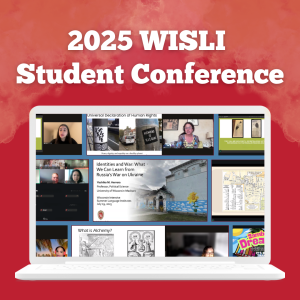
Our keynote speaker was Yoshiko M. Herrera (Professor of Political Science at UW–Madison).
Prof. Herrera gave a talk titled “Identity and War: What We Can Learn from Russia’s War on Ukraine.”
Keynote lecture abstract: The full-scale Russian invasion of Ukraine in 2022 has reinvigorated debates about the causes of war. The question of why Vladimir Putin launched a full-scale war in 2022 does not seem to be answered by many usual explanations, e.g. material interests or threats to international security. We argue that Russia’s imperial ambitions and sense of Russian national identity heavily shaped Russian President Vladimir Putin’s decision to launch the full scale invasion. Yet, importantly, identity in this case is not reducible to ethnicity: While identity factors are central to the cause of the Russian full-scale invasion of Ukraine, ethnicity per se does not matter that much in this war, or at least it does not matter in the way that much of the literature might have thought it would.
Hence, one of the challenges for International Relations theory that has been brought up by the Russian war in Ukraine is that we need to update and improve our understanding the role of identity in conflict and political violence. Identity is not the only factor in the causes of the war, and changes in identities are not the only, nor most important consequences of the war, but for theories of war, the Russian invasion and war in Ukraine compels us take another look at how we understand the relationship between identity and war. In this paper we map out a theoretical framework for identity and conflict, and then discuss relevant aspects of identity in both Ukraine and Russia, with an emphasis on how identities might have contributed to the war and been changed as a consequence.
Speaker Bio: Yoshiko M. Herrera is Professor of Political Science at University of Wisconsin–Madison. Her research focuses on Russian & Eurasian politics, identity, and international norms. Herrera teaches courses on comparative politics, social identities and diversity, and a new course on the Russian war on Ukraine. She was a recipient of the Chancellor’s Distinguished Teaching Award at UW–Madison in 2021, and a Distinguished Honors Faculty Award from the College of Letters & Science Honors Program at UW–Madison in 2024. She is the author of two books and an influential co-edited volume on Measuring Identity. Her most recent co-authored article, is “Don’t Look Back in Anger: Cooperation Despite Conflicting Historical Narratives” published in the American Political Science Review.
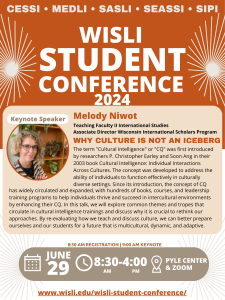
The 2024 WISLI Student Conference was held on June 29, 2024 from 8:30am – 4:00pm.
It was located at the Pyle Center on the 3rd floor and a Zoom link was provided for online participants.
Our keynote speaker was Melody Niwot (Teaching Faculty II International Studies, Associate Director Wisconsin International Scholars Program)
Melody Niwot delivered a talk titled “Why Culture Is Not An Iceberg”.
Keynote lecture abstract: The term “Cultural Intelligence” or “CQ” was first introduced by researchers P. Christopher Earley and Soon Ang in their 2003 book Cultural Intelligence: Individual Interactions Across Cultures. The concept was developed to address the ability of individuals to function effectively in culturally diverse settings. Since its introduction, the concept of CQ has widely circulated and expanded, with hundreds of books, courses, and leadership training programs to help individuals thrive and succeed in intercultural environments by enhancing their CQ. In this talk, we will explore common themes and tropes that circulate in cultural intelligence trainings and discuss why it is crucial to rethink our approaches. By re-evaluating how we teach and discuss culture, we can better prepare ourselves and our students for a future that is multicultural, dynamic, and adaptive.
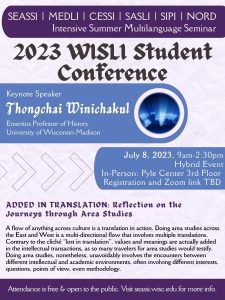
The 2023 WISLI Student Conference was held on July 8th, 2023 from 9am to 4pm.
It was located at the Pyle Center on the 3rd floor (rooms 309, 313, and 315) and a Zoom link was provided for online participants.
Our keynote speaker was Thongchai Winichakul (Emeritus Professor of History, University of Wisconsin- Madison).
Prof. Winichakul delivered a talk titled “Added in Translation: Reflection on the Journeys through Area Studies”
Keynote lecture abstract: A flow of anything across culture is a translation in action. Doing area studies across the East and West is a multi-directional flow that involves multiple translations. Contrary to the cliché “lost in translation”, values and meanings are actually added in the intellectual transactions, as so many travelers for area studies would testify. Doing area studies, nonetheless, unavoidably involves the encounters between different intellectual and academic environments, often involving different interests, questions, points of view, even methodology.
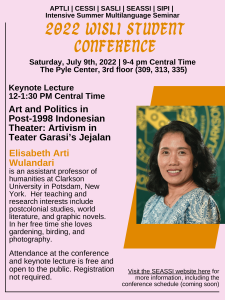
The 2022 WISLI Student Conference was held on Saturday, July 9th from 9:30am – 4:00 pm in the Pyle Center at UW–Madison. Parallel sessions were held in Rooms 309, 313, and 335 throughout the day. Coffee/tea and a boxed lunch were provided for conference attendees.
We are pleased to have Dr. Elisabeth Arti Wulandari as this year’s keynote speaker! Dr. Wulandari will present her talk entitled “Art and Politics in Post-1998 Indonesian Theater: Artivism in Teater Garasi’s Jejalan.”
Keynote lecture abstract: A longstanding literary debate pits art-for-art’s-sake against politically-engaged art. In Indonesia, political events reignited this debate in post-1998 Indonesian theater, following the fall of Soeharto’s authoritarian regime. Not only did the year 1998 see revolutionary political reformation, it also ushered in a social and cultural revolution. Before 1998, the New Order Regime was often depicted in Indonesian drama as the common enemy of the people. Post-1998, that shared political target was no longer in power, and the need to criticize the repressive state had arguably diminished. So, how have Indonesian theater practitioners transformed their performative practices since 1998, and to what extent do the forms and themes of pre-1998 theater still speak to a post-1998 society and its attending problems?
As with the rest of Indonesian theater, the post-1998 years were an important turning point for the Yogyakarta-based theater troupe Teater Garasi. Teater Garasi, along with a host of other activist, social and cultural organizations, saw a rapidly changing society and felt the need to respond in a way that would take advantage of the cultural moment, and to ensure that theater remained relevant to the new social and political reality around them. But Teater Garasi didn’t just care about the political and social dimensions of their plays; they also cared about the aesthetics, and about technique. My presentation situates Teater Garasi’s cultural activism in post-1998 Indonesia, examining how their understanding of what theater should look like after 1998 shaped their performative practices. I will specifically discuss Teater Garasi’s 2008 performance Je.Ja.Lan, and examine the ways in which it exemplifies “artivism” in Indonesian theater.